
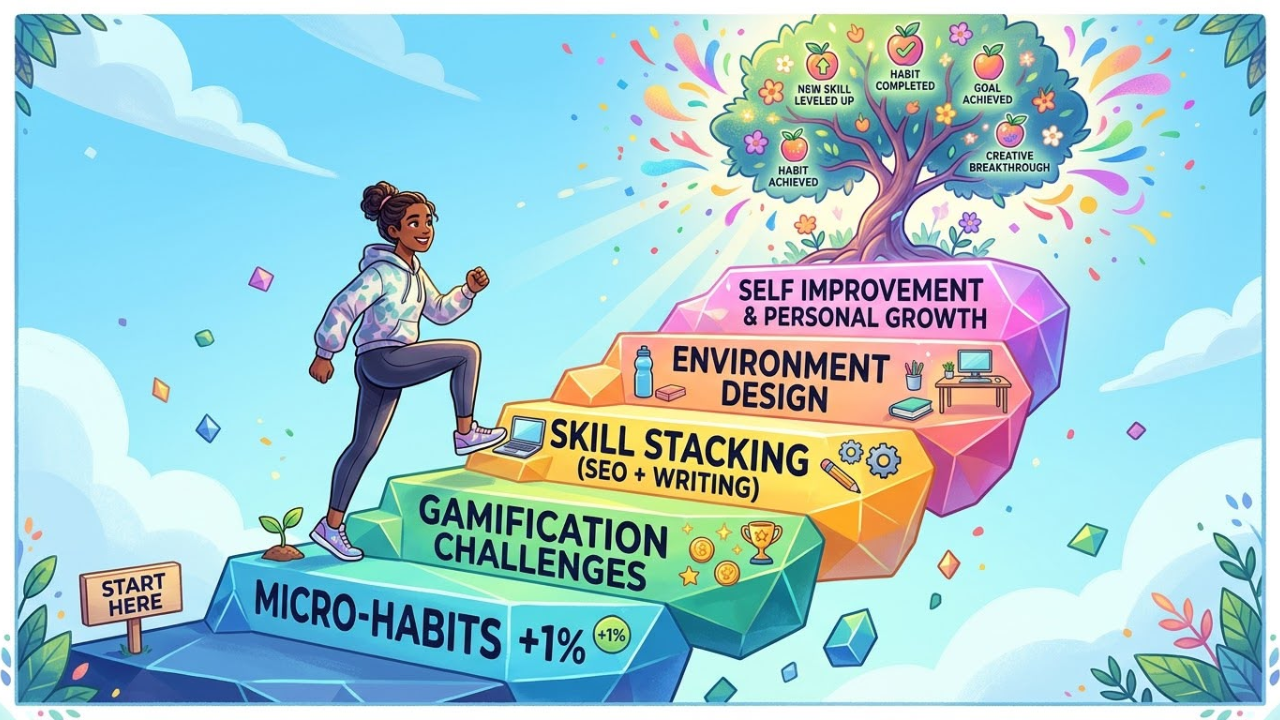
We all want to level up our lives. We want to master new skills, build healthier habits, crush our career goals, and become the best version of ourselves. But let’s be honest: traditional self-improvement can feel exhausting, rigid, and downright boring.
Waking up at 5:00 AM, adhering to strict diets, pushing through grueling workouts, and tracking every minute of the day often feels more like a punishment than progress. This pressure to be constantly productive is precisely why most people burn out and quit after just a few weeks.
What if self-improvement didn’t have to feel like a chore? A cool way to improve What if improving yourself was exciting, engaging, and genuinely cool?
In this article, we’ll explore fresh, innovative, and enjoyable strategies to transform personal growth from a tedious routine into an exciting journey you look forward to every day.
Section 1: Gamify Your Life: Turn Progress Into a Video Game
Have you ever wondered why video games are so addictive? Games keep us hooked because they offer clear objectives, instant feedback, thrilling challenges, and rewarding milestones. When you fail a level in a game, you don’t give up forever—you simply analyze what went wrong and try again with a better strategy.
You can apply this exact mindset to your everyday life:
- Create a Point System: Assign points to your daily positive habits. For example: waking up on time (+10 points), reading 10 pages of a book (+15 points), skipping sugary drinks (+20 points), or completing a tough workout (+25 points).
- Define “Level-Ups” and Rewards: Establish milestones. Reaching 500 points unlocks a reward, such as buying that book you’ve wanted, taking a weekend day trip, or enjoying your favorite cheat meal.
- Track Your Quests: Treat your long-term goals as main quests and daily tasks as side quests.
When self-improvement feels like playing a game, your brain swaps feelings of dread for feelings of excitement and curiosity.
Section 2: The 1% Rule: The Power of Micro-Habits
A common mistake in self-improvement is trying to overhaul your entire life overnight. People buy annual gym memberships, order five heavy non-fiction books, and cut out all carbs in a single day. Unsurprisingly, this extreme approach leads to quick burnout.
Instead, embrace The 1% Rule. Made famous by James Clear in Atomic Habits, this concept shows that getting just 1% better each day compounds into extraordinary results over time. In fact, if you improve by 1% every day for a year, you will end up 37 times better by the end of it.
Here is how to start small:
- Meditate for just 2 minutes every morning.
- Read just 2 pages of a book before sleep.
- Do 5 push-ups after brushing your teeth.
These micro-changes are so small they don’t trigger resistance or fear in your brain. Yet, over months and years, these tiny daily wins accumulate into massive transformations.
Section 3: Skill Stacking: Create Your Superpower Combination
In today’s fast-moving world, becoming the world’s absolute best at one single skill is incredibly difficult. However, becoming above-average at two or three complementary skills is entirely achievable—and far more powerful. This technique is known as Skill Stacking.
Rather than striving to be in the top 1% of a single discipline, combine multiple skills to create a unique value proposition that sets you apart.
Consider these powerful combinations:
- Writing + Public Speaking + Basic Design: Makes you an exceptional communicator, presenter, and content creator.
- Coding + Basic Marketing + Data Analysis: Gives you all the tools needed to build and launch a successful tech startup independently.
- Domain Expertise + Storytelling: Turns complex technical knowledge into engaging stories people love to consume.
Skill stacking makes you uniquely valuable in your career without requiring a lifetime of single-focused mastery.
Section 4: Environment Design: Stop Relying Solely on Willpower
Many people believe that successful individuals possess superhuman willpower. The reality is that willpower is a limited resource that depletes throughout the day. Relying on self-control alone to resist distractions or bad habits is a losing strategy.
A cooler, far more effective approach is Environment Design—shaping your surroundings so that good choices become effortless and bad choices become difficult.
- To build good habits: Place your workout clothes right next to your bed, keep a bottle of water on your desk, or leave a book on your pillow.
- To break bad habits: Leave your smartphone in another room while working, remove junk food from your pantry, or use app blockers during focus hours.
When your environment works for you instead of against you, improving yourself requires almost no friction.
Section 5: Embrace Micro-Learning and Active Listening
Finding hours of uninterrupted time to sit down and study can feel impossible with a busy schedule. Micro-learning solves this by turning “dead time” into productive learning sessions.
Make learning a seamless part of your daily rhythm:
- Audiobooks & Podcasts: Listen to industry podcasts, audiobooks, or educational lectures during your commute, while walking the dog, or while doing household chores.
- Curated Content: Clean up your social media feeds. Unfollow accounts that drain your energy and follow creators who share quick insights on psychology, finance, tech, or personal health.
By integrating micro-learning into your daily routine, you effortlessly absorb new knowledge and perspectives without sacrificing extra time.
Section 6: Build a Feedback Loop: Become Your Own Mentor
Growth requires reflection. Without self-awareness, it’s easy to repeat the same mistakes week after week. Setting up a simple, lighthearted reflection routine allows you to track your trajectory objectively.
At the end of every week, take 5 minutes to answer three simple questions:
| Reflection Question | Focus Area | Goal |
| 1. What went well this week? | Victories | Celebrate progress, big or small. |
| 2. Where did I get off track? | Friction Points | Analyze obstacles without self-judgment. |
| 3. What is one tweak I can make? | Adaptation | Implement a tiny adjustment for next week. |
Keeping a short journal or digital note for these weekly reflections keeps you mindful, accountable, and continuously adapting.
Conclusion
Self-improvement isn’t a race, nor is it a test you can fail. It’s an ongoing, creative experiment with yourself. You don’t need to be perfect every single day; you just need to keep showing up and keeping things fresh.
“A cool way to improve” means dropping the guilt, letting go of unrealistic expectations, and enjoying the process. Turn your goals into games, focus on tiny 1% gains, design a supportive environment, and celebrate your wins along the way.
Start small today, keep it fun, and watch how quickly your life evolves!
Also Read: Gaming Vivid2201 Patches: What They Are, Features, Benefits, and Safety Guide